Imago Dei: What It Means to Reflect the God You Follow
Imago Dei is Latin for “image of God.”
Long before Scripture speaks about human achievement, usefulness, influence, status, or recognition, it tells us something more fundamental about humanity:
We were made by God.
And we were made in His image.
“Then God said, ‘Let us make man in our image, after our likeness.’” — Genesis 1:26
Genesis 1:26–27 establishes this identity before anything humanity accomplishes.
We do not earn the image.
We bear it by creation.
Scripture continues to speak of human beings as made in God's likeness even after the Fall (Genesis 9:6; James 3:9).
That means human dignity is not something achievement can give.
Productivity cannot grant it.
Culture cannot assign it.
Status cannot increase it.
And clothing certainly cannot create it.
God established it first.
Being made in God's image tells us something about who made us, whose creatures we are, and the dignity God has placed upon human life.
But if we are going to speak about what it means to faithfully reflect the God whose image we bear, we cannot begin with ourselves.
We begin with Him.
──────────◆──────────
Reflection Begins With the Source
Scripture tells us:
“God is love.” — 1 John 4:8
That does not mean love is the only thing Scripture tells us about God.
He is holy.
Righteous.
Truthful.
Just.
Merciful.
Faithful.
Good.
But Scripture does not merely say that God loves.
It says God is love.
So faithful reflection cannot be defined by whatever we happen to call loving.
God defines it.
His character defines the standard.
His Word tells us what is true.
And His Son reveals Him perfectly.
That is why Christian reflection is not self-expression with religious language added to it.
We do not look inward, decide what goodness should mean, and then project that definition back onto God.
The Source defines the reflection.
And even our capacity to love begins with Him:
“We love because he first loved us.” — 1 John 4:19
God initiates.
We respond.
That order matters.
──────────◆──────────
Christ Is More Than an Example
If we want to know what God is like, Christianity does not point us merely toward a set of principles.
It points us toward Christ.
Colossians 1:15 calls Jesus “the image of the invisible God.”
Hebrews 1:3 describes the Son as “the exact imprint of his nature.”
And Jesus says:
“Whoever has seen me has seen the Father.” — John 14:9
Christ is therefore more than a moral example for image-bearers to imitate.
He uniquely reveals the Father.
In Him, we see holiness without coldness.
Truth without deceit.
Authority without selfish ambition.
Compassion without compromise.
Service without performance.
Obedience without rebellion.
Love that gives itself for others without ceasing to be righteous and true.
And nowhere is that love displayed more fully than at the cross.
But the distinction must remain clear.
Jesus Christ alone is Savior.
His death is not simply an inspiring model of sacrifice.
He gave Himself for sinners in a saving work we cannot repeat, reproduce, or equal.
Our faithfulness does not stand beside His.
It depends upon His.
And the Christ who saves His people is also the One into whose likeness they are being formed.
Romans 8:29 says believers are being conformed to the image of His Son.
Second Corinthians 3:18 describes believers as being transformed into that image.
Christian reflection, then, is not an attempt to become impressive enough to resemble Jesus.
It is the fruit of belonging to Him.
──────────◆──────────
The Spirit Produces What Effort Alone Cannot
Being formed into Christ's likeness does not mean human obedience becomes unnecessary.
Scripture calls believers to act.
Obey.
Repent.
Practice self-control.
Put away sin.
Pursue holiness.
Remain faithful.
But Scripture never presents Christian transformation as a self-powered project.
Jesus said:
“Apart from me you can do nothing.” — John 15:5
And Paul tells believers to work out what God is doing within them because:
“It is God who works in you, both to will and to work for his good pleasure.” — Philippians 2:13
There is effort.
But there is no independence.
The Christian does not manufacture the character of God through sufficient discipline.
The Spirit produces what self-effort cannot create.
Galatians 5:22–23 names love, joy, peace, patience, kindness, goodness, faithfulness, gentleness, and self-control as the fruit of the Spirit.
That keeps Imago Dei from becoming a message of:
Try harder to represent God.
The biblical movement is deeper than that.
God created us.
Christ redeems His people.
The Spirit transforms them.
And believers respond through dependent obedience.
The reflection becomes increasingly visible because God is at work in the person who belongs to Him.
──────────◆──────────
The Household Brings the Reflection Close
Scripture repeatedly brings faith into ordinary household life.
Israel was commanded to speak of God's words with their children while sitting at home, walking along the way, lying down, and rising again (Deuteronomy 6:6–7).
The New Testament speaks directly into the lives of husbands and wives, parents and children, because faith was never intended to remain a public confession disconnected from private life (Ephesians 5:21–6:4; Colossians 3:12–21).
The household does not create the image we bear.
And home is not the only place Christian character matters.
But for those entrusted with a household, it becomes one of the closest places where formation can be experienced by others.
The people nearest to us encounter more than what we say we believe.
They encounter our patterns.
Whether patience survives inconvenience.
Whether truth remains loving when correction is necessary.
Whether authority serves or controls.
Whether forgiveness is practiced.
Whether repentance follows failure.
Whether our presence matches our promises.
The household brings formation close enough to be experienced.
Faith moves from confession into rhythm.
And character becomes visible through the ordinary responsibilities of life.
──────────◆──────────
Made in His Image. Formed to Reflect Him.
Imago Dei begins with something God has already done.
Humanity was created in His image.
Genesis 1:26–27 establishes that reality before human achievement, status, usefulness, influence, or accomplishment.
We do not earn the image.
We bear it by creation.
That is why human dignity cannot be reduced to performance.
But Scripture also tells another part of the story.
Sin has distorted human life.
Although humanity continues to bear God's image, we do not naturally display His character faithfully in everything we desire, say, build, or do.
For those who belong to Christ, Scripture therefore speaks of renewal.
The new self is:
“being renewed in knowledge after the image of its creator.” — Colossians 3:10
Believers are being transformed into the image of Christ (2 Corinthians 3:18).
They are being conformed to the image of God's Son (Romans 8:29).
That gives us an important distinction:
Made in His image by creation.
Formed to reflect Him through redemption and sanctification.
The first establishes dignity.
The second describes transformation.
We do not become image-bearers by behaving well.
And we do not become the Source through spiritual maturity.
God remains God.
Christ remains Savior and King.
The Spirit remains the One producing His fruit within His people.
We remain dependent creatures receiving everything from Him.
You are not the Source.
You are the bearer.
And for those in Christ, the character of the God they follow should become increasingly visible in the way they live.
Not perfectly.
Not independently.
Not as a substitute for Christ.
But increasingly, by His grace.
Made in His image.
Formed to reflect Him.
──────────◆──────────
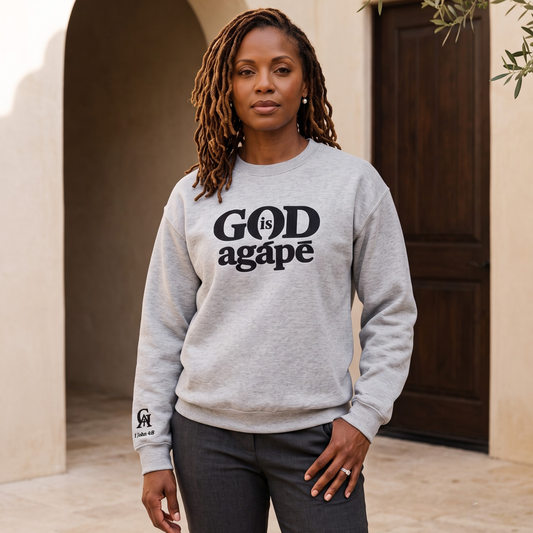
What This Has to Do With Wearing Anything
LHV did not create Imago Dei.
And apparel cannot give anyone what God has already established by creation.
A garment cannot make someone an image-bearer.
It cannot produce Christlike character.
It cannot perform the transforming work of the Holy Spirit.
What clothing can do is give visible expression to a truth that existed long before the garment did.
That is the purpose behind the Imago Dei — Image Bearer Collection.
It was created not to give someone an identity, but to give wearable form to a truth Scripture established before the clothing existed.
The meaning comes first.
The garment follows.
When IMAGO DEI or IMAGE BEARER appears on a piece, the clothing is not announcing that the wearer has achieved spiritual perfection.
It points backward.
To the Creator.
To the dignity He established.
To Christ, who perfectly reveals the Father.
To the Spirit, who forms Christ's people.
And to the responsibility of living as someone whose life belongs to God.
The garment is the expression.
God remains the Source.
──────────◆──────────
Open Your Bible
Read these passages slowly and let Scripture shape your understanding of what it means to bear God's image and, for those in Christ, to be formed to reflect Him:
- Genesis 1:26–28
- Genesis 9:6
- James 3:9
- Colossians 1:15–20
- Hebrews 1:1–3
- John 14:8–11
- Romans 8:28–30
- 2 Corinthians 3:17–18
- Colossians 3:9–14
- Ephesians 4:20–24
- John 15:1–5
- Galatians 5:16, 22–25
- Philippians 2:12–13
- Deuteronomy 6:4–9
- Ephesians 5:21–6:4
- 1 John 4:7–19
God is the Source.
You bear His image.
In Christ, His people are being formed to reflect Him.